

Are you looking for a trusted, experienced Pandit for Rudrabhishek Puja in Bangalore?
Whether it is your first time performing this sacred Shiv Puja or you have been doing it for years, finding the right Pandit who understands the authentic Vedic traditions makes all the difference.
At North Indian Pandits, we connect families in Bangalore with verified, Hindi-speaking North Indian Pandits who perform Rudrabhishek Puja with complete authenticity, proper Sankalp, and full Vidhi. With over 15 years of experience and hundreds of satisfied families across Bangalore, we are here to make your Puja truly meaningful.
This guide covers everything you need to know — the meaning of Rudrabhishek, the complete Vidhi, Samagri list, Muhurat, costs, and how to book a Pandit near you in Bangalore today.
What is Rudrabhishek Puja?
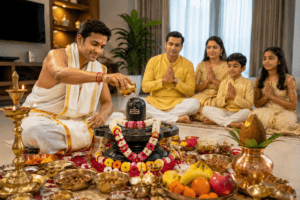
Rudrabhishek is one of the most powerful Pujas dedicated to Lord Shiva. The word itself comes from two Sanskrit roots: Rudra — a fierce, powerful form of Shiva — and Abhishek — the sacred act of bathing or anointing a deity. Together, Rudrabhishek means the ritual bathing of Lord Rudra (Shiva) with sacred substances while chanting specific Vedic mantras.
During Rudrabhishek, the Shivalinga is ceremonially anointed with Panchamrit (a mixture of five sacred substances), water from holy rivers, honey, sugarcane juice, and other offerings while the Pandit chants the Sri Rudram and Chamakam from the Yajurveda. The vibrations created by these ancient Vedic chants are believed to purify the environment, remove negative energies, and invite divine blessings into your home.
Unlike simpler daily Shiv Pujas, Rudrabhishek is an elaborate, time-tested ritual that follows a precise sequence. It requires a knowledgeable Pandit who has trained in the proper pronunciation and rhythm of Vedic mantras — which is why choosing the right Pandit matters so much.
Who Should Perform Rudrabhishek Puja?
Rudrabhishek Puja is for everyone who seeks the blessings of Lord Shiva. Specifically, it is highly recommended for:
- Families seeking health, prosperity, and peace in their home
- Individuals facing persistent health problems or chronic illnesses
- Those experiencing career setbacks, financial difficulties, or business losses
- Couples struggling with marital discord or relationship issues
- People facing obstacles in education, promotions, or government matters
- Individuals with a strong Saturn (Shani) placement in their horoscope
- Those with Kaal Sarp Dosh, Pitra Dosh, or other Vedic Doshas
- Anyone who wishes to begin an important new chapter in life — a new home, a new business, or a new phase of spiritual practice
- Devotees of Lord Shiva who want to express gratitude and deepen their connection
There is no age restriction for Rudrabhishek. Children, elders, men, and women can all participate. The Puja can be performed individually, as a couple, or as a full family.
Benefits of Rudrabhishek Puja:
The Shiva Purana and Vedic scriptures describe Rudrabhishek as one of the most complete and powerful Pujas a devotee can perform. Here are the key benefits:
Spiritual Benefits
- Removes accumulated negative karma over multiple lifetimes
- Cleanses the mind, body, and soul of impurities
- Deepens spiritual practice and brings inner peace
- Creates a powerful protective shield against evil eye and negative energies
Health Benefits
- The Mahamrityunjaya Mantra chanted during Rudrabhishek is known as the “death-conquering mantra” — it is specifically associated with healing, recovery from illness, and long life
- Believed to help with chronic diseases, recurring health issues, and mental stress
- Creates positive vibrations that support overall well-being
Material and Life Benefits
- Removes obstacles from career and business
- Attracts prosperity and financial stability
- Resolves long-pending court cases or government disputes
- Helps overcome Kaal Sarp Dosh, Mangal Dosh, and other planetary afflictions
- Brings harmony in relationships and family life
- Blesses childless couples seeking progeny
Best Occasions to Perform Rudrabhishek Puja
While Rudrabhishek can be performed on any day with proper Muhurat, certain times are considered especially auspicious for this Puja:
Monday (Somvar)
Monday is Lord Shiva’s day. Performing Rudrabhishek on a Monday, especially during the early morning hours, is considered extremely auspicious. The blessings received on Mondays are believed to be multiplied many times over compared to other days.
Pradosh Vrat
Pradosh occurs on the 13th day of both the waxing and waning lunar cycles (Trayodashi). The evening twilight period (Pradosh Kaal) on these days is considered one of the most powerful windows for Shiva worship. A Rudrabhishek performed during Pradosh Kaal is believed to fulfil desires rapidly.
Shravan Month
The entire month of Shravan (roughly July–August) is sacred to Lord Shiva. Every Monday during Shravan holds special significance. Performing Rudrabhishek during Shravan is one of the most meritorious acts a Shiva devotee can undertake.
Mahashivratri
This is the grandest occasion for Rudrabhishek. Mahashivratri falls on the 14th night of the dark fortnight in Phalguna (February–March). Performing Rudrabhishek through the night on Mahashivratri is considered equivalent to performing the Puja thousands of times on ordinary days.
Kartik Month
The month of Kartik (October–November) is another highly auspicious period for Shiva worship. Rudrabhishek performed during Kartik is believed to bring swift relief from Doshas and grant the blessings of moksha.
Other Auspicious Times
-
- Amavasya (New Moon Day)
- Solar and Lunar Eclipses (performed before the eclipse period)
- Birthdays and Anniversaries
- Griha Pravesh (House Warming)
- Navratri
- New Year (Hindu calendar)
🙏 Looking for a Verified North Indian Pandit for Rudrabhishek Puja in Bangalore?
Call +91 7483385930 today and book an experienced Vedic Pandit from North Indian Pandits.
✅ Verified Pandits | ✅ 15+ Years Experience | ✅ Samagri Included Option
✅ Hindi & Sanskrit | ✅ On-Time Arrival | ✅ Same Day Booking | ✅ All Bangalore Areas
Scriptural Importance of Rudrabhishek
According to the Shiva Purana
The Shiva Purana — one of the eighteen major Puranas — dedicates extensive chapters to the glory of Rudrabhishek. The text states that among all forms of worship offered to Lord Shiva, the Abhishek performed with proper Vedic mantras yields the highest spiritual merit. The Purana describes how even gods and celestial beings performed Rudrabhishek to seek Shiva’s blessings during times of cosmic distress. It mentions that a devotee who performs Rudrabhishek with pure intentions and proper Vidhi will be freed from the cycle of birth and death.
According to the Vedas
Rudrabhishek is deeply rooted in the Vedic tradition, specifically in the Krishna Yajurveda. The Sri Rudram — the most sacred hymn dedicated to Rudra — forms the backbone of this Puja. The Vedas describe Rudra as the healer of all diseases, the destroyer of all evil, and the bestower of all auspiciousness. Chanting the Sri Rudram while performing Abhishek is said to invoke Rudra’s most benevolent aspect, transforming his fierce energy into healing and protective grace.
According to Sri Rudram and Chamakam
Sri Rudram consists of two parts: the Namakam (eight Anuvaka sections calling upon Rudra by his many names and asking for his grace) and the Chamakam (eleven Anuvaka sections listing all that the devotee requests from Rudra — health, wealth, strength, progeny, wisdom, and ultimately liberation). Together, the Sri Rudram and Chamakam cover every dimension of human life and aspiration, making this the most complete prayer in the Vedic tradition.
Importance of Sacred Elements in Rudrabhishek
Importance of the Mahamrityunjaya Mantra
The Mahamrityunjaya Mantra (“Om Tryambakam Yajamahe…”) is chanted during Rudrabhishek as the primary healing invocation. This mantra appears in the Rigveda and is addressed to Tryambaka — the three-eyed Shiva. It is called the “death-conquering” mantra because it is believed to protect the devotee from untimely death, severe illness, and the fear of death itself. When chanted 108, 1008, or 11,000 times during Rudrabhishek, its potency is magnified enormously.
Importance of Abhishek
Abhishek — the ceremonial bathing of the deity — is considered the highest form of worship in Shaiva tradition. When the Shivalinga is bathed in sacred substances, each substance carries a specific prayer and intention. Water washes away sins; milk brings purity and nourishment; honey represents sweetness in life; curd confers prosperity; ghee brings wisdom and light. The physical act of Abhishek combined with Vedic chanting creates an energetic resonance that purifies the entire space.
Importance of Bilva Leaves
The Bilva (Bael) leaf is dearest to Lord Shiva. Scriptures state that offering a single Bilva leaf to Shiva with devotion is equivalent to performing great sacrificial rituals. The three-lobed leaf represents the Trishula (trident) of Shiva and also symbolises the three gunas — Sattva, Rajas, and Tamas — all of which Shiva transcends. During Rudrabhishek, Bilva leaves are offered at each stage of the Abhishek with specific mantras.
Importance of Rudraksha
Rudraksha beads are considered the tears of Shiva. The word “Rudraksha” means “Rudra’s eye.” Wearing Rudraksha and offering it during Puja is considered highly auspicious. A Rudraksha mala used for chanting the Mahamrityunjaya Mantra during Rudrabhishek amplifies the effect of the mantra and creates a protective aura around the devotee.
Importance of Panchamrit
Panchamrit is a mixture of five sacred substances used for Abhishek: raw cow’s milk (Dugdha), curd (Dadhi), pure ghee (Ghrita), honey (Madhu), and sugar (Sarkara). Each ingredient carries symbolic and spiritual significance. Together, Panchamrit represents completeness — the five elements, the five senses, and the five offerings of the body and mind to the divine. After Abhishek, Panchamrit is distributed as Prasad and consuming it is believed to bestow health and divine grace.
Complete Rudrabhishek Vidhi
The Vidhi (prescribed method) of Rudrabhishek follows a precise traditional sequence. Here is the complete Vidhi as performed by our experienced North Indian Pandits:
1. Shuddhi (Purification)
The Puja space, the devotee, and all materials are purified using Ganga Jal (holy water), Pancha Gavya, and specific mantras. The Pandit purifies himself and consecrates the space by invoking the Pancha Bhutas (five elements).
2. Kalash Sthapana
A sacred Kalash (copper or brass pot) filled with water, mango leaves, and a coconut is established as the divine seat of Lord Varuna and the holy rivers. This Kalash water is later used in Abhishek.
3. Ganesh Puja
All Vedic rituals begin with the worship of Lord Ganesha to remove obstacles and ensure the successful completion of the Puja.
4. Navagraha Puja
The nine planetary deities are invoked and propitiated so that their influences are favourable during and after the Puja.
5. Sankalp
The devotee states their intention — the specific purpose of the Puja — through a formal Sankalp, which is described in detail in the next section.
6. Shiva Dhyana and Avahan
Lord Shiva is invoked and welcomed into the Shivalinga through specific Vedic mantras and flowers.
7. Shodashopachara Puja
Shiva is offered sixteen types of services (Upacharas), including a seat, water for feet, Arghya, Achamana, bathing, clothing, the sacred thread, perfume, flowers, incense, lamp, and food offerings.
8. Sri Rudra Parayana
The Pandit chants the full Sri Rudram (Namakam and Chamakam) from the Yajurveda. Depending on the type of Rudrabhishek — Laghu, Ekadash, or Maharudra — this may be chanted once, eleven times, or 121 times respectively.
9. Rudrabhishek (Main Abhishek Ritual)
As the Sri Rudram is chanted, the Shivalinga is bathed in sequence with: Jal (water), Panchamrit, Gangajal, Sugarcane Juice, Coconut Water, Honey, Curd, Ghee, Milk, and finally flower water. Each Abhishek substance is offered with specific mantras and intentions.
10. Bilva Archana
One hundred and eight (or 1008) Bilva leaves are offered to the Shivalinga, each accompanied by a mantra from the Shiva Sahasranama or the Ashtotra Shatanama.
11. Maha Aarti
A grand Aarti is performed for Lord Shiva with the traditional lamps, camphor, and conch shell.
12. Pradakshina and Namaskar
The devotee circumambulates the Shivalinga and offers prostrations.
13. Prasad Distribution
The Panchamrit used in Abhishek, along with other Prasad items like fruits and sweets, is distributed among all present.
Step-by-Step Puja Process at Your Home
Here is what happens when you book North Indian Pandits for Rudrabhishek Puja at your home in Bangalore:
-
-
- Booking Confirmation: You call or WhatsApp us at +91 7483385930. We confirm the date, time, and your location in Bangalore.
- Pandit Arrival: Our verified Pandit arrives 30 minutes before the scheduled Puja time to set up the sacred space.
- Samagri Setup: The Pandit arranges all Puja Samagri on a clean Chowki (wooden platform) and prepares the Kalash and Shivalinga.
- Briefing the Family: The Pandit explains the Puja to the family, including what they need to do during Sankalp and key moments.
- Puja Begins: The complete Rudrabhishek Puja proceeds as described in the Vidhi above.
- Prasad: Panchamrit and other Prasad are distributed to the family after the Puja.
- Guidance: The Pandit provides post-Puja guidance — what to do with the sacred items, any specific prayers to continue, and follow-up Puja recommendations if applicable.
-
Sankalp – The Sacred Intention
The Sankalp is one of the most important moments in any Vedic Puja, and especially in Rudrabhishek. It is the formal declaration of the devotee’s intention and purpose before Lord Shiva.
During Sankalp, the devotee holds a small amount of water, Akshat (unbroken rice), and a coin in their joined hands while the Pandit recites specific mantras. The Pandit incorporates the following elements into the Sankalp:
-
-
- Today’s exact date in both the Gregorian and Hindu calendar (Vikram Samvat)
- The current Tithi (lunar day), Vara (weekday), Nakshatra (star), and Yoga
- The name of the devotee and their Gotra (lineage)
- The specific purpose of the Puja (health, prosperity, removal of Dosha, etc.)
- A prayer that Lord Shiva accepts the Puja and fulfils the devotee’s wish
-
This is why it is important to have a Pandit who speaks Hindi or Sanskrit — so the family can understand the Sankalp and participate meaningfully. Our North Indian Pandits explain the Sankalp in simple Hindi or English so every family member is connected to the purpose of the Puja.
Complete Puja Samagri List for Rudrabhishek
Here is a complete list of all items required for Rudrabhishek Puja. If you opt for our Puja with Samagri service, all these items are brought by our Pandit. If you prefer to arrange Samagri yourself, use this as your checklist:
| Category | Item | Quantity / Notes |
|---|---|---|
| Main Deity & Setup | Shivalinga (with Panchayatana if desired) | 1 (provided by family or Pandit) |
| Copper or Brass Kalash | 1 large, 1–2 small | |
| Wooden Chowki (altar platform) | 1 | |
| Panchapatri (5-leaf vessel) | 1 | |
| Red or Yellow Cloth (for Chowki) | 1 yard | |
| Panchamrit Items | Raw Cow’s Milk (Dugdha) | 500 ml |
| Curd (Dadhi) | 200 ml | |
| Pure Ghee (Ghrita) | 100 ml | |
| Honey (Madhu) | 100 ml | |
| Sugar (Sarkara) | 50 g | |
| Abhishek Liquids | Gangajal (holy water) | 500 ml |
| Coconut Water | 1 coconut | |
| Sugarcane Juice | 250 ml | |
| Rose Water | 100 ml | |
| Flowers & Leaves | Bilva Leaves (Bael) | 108 or 1008 (fresh, three-lobed) |
| White Flowers (Dhatura, Jasmine, or White Lotus) | 1 bunch | |
| Marigold Garland | 1–2 | |
| Mango Leaves (for Kalash) | 5–7 | |
| Lamps & Incense | Earthen Diyas | 5–11 |
| Camphor (Kapoor) | 1 packet | |
| Incense Sticks (Agarbatti) | 1 packet (Sandalwood preferred) | |
| Cow Ghee Lamp (Akhand Diya) | 1 (for Aarti) | |
| Pancha Diya (five-wick lamp) | 1 | |
| Ritual Items | Akshat (unbroken rice, dyed with kumkum) | 200 g |
| Kumkum (vermillion) | 1 small packet | |
| Sandalwood Paste (Chandan) | 1 stick or small jar | |
| Vibhuti (sacred ash) | 1 small pack | |
| Rudraksha Mala | 1 (for chanting) | |
| Offering Items | Fruits (Banana, Coconut, Mango or seasonal) | Assorted |
| Bhog (sweet offering — Kheer or Halwa preferred) | 1 bowl | |
| Pan (betel leaf), Supari, Laung, Elaichi | 5 sets | |
| Dakshina (coins or currency for Pandit) | As per your offering |
Note: When you book North Indian Pandits with the Samagri package, our Pandit brings all the above items. You only need to provide a clean space and a water source.
Muhurat and Best Days for Rudrabhishek in Bangalore
Choosing the right Muhurat significantly enhances the benefits of Rudrabhishek Puja. Our Pandits are well versed in Vedic Panchang (almanac) and will guide you to the most auspicious time based on your date of birth, Rashi (moon sign), and the specific purpose of your Puja.
General Muhurat Guidelines:
| Time Window | Name | Auspiciousness |
|---|---|---|
| 4 AM – 6 AM | Brahma Muhurta | ⭐⭐⭐⭐⭐ Highest auspiciousness |
| 6 AM – 8 AM | Pratah Kaal | ⭐⭐⭐⭐ Very auspicious |
| Evening twilight (6–7 PM) | Pradosh Kaal | ⭐⭐⭐⭐⭐ Best for Shiva Puja |
| Midnight (12–1 AM on Mahashivratri) | Nishita Kaal | ⭐⭐⭐⭐⭐ Special for Mahashivratri |
Why Choose North Indian Pandits for Rudrabhishek in Bangalore?
✅ Why Families Across Bangalore Trust Us
- 🔍 Verified Pandits: Every Pandit on our team is personally verified for qualifications, background, and knowledge of Vedic rituals. No surprises, no amateurs.
- ⏳ 15+ Years of Experience: Our Pandits have performed Rudrabhishek Puja for thousands of families across Bangalore and across India. They know every nuance of the ritual.
- 💰 Affordable & Transparent Pricing: We quote a clear price upfront. No hidden charges, no last-minute additions. What we quote is what you pay.
- ⏰ On-Time Arrival Guarantee: We understand the importance of Muhurat. Our Pandits always arrive on time — and usually 30 minutes early to set up.
- 🕉️ Authentic Vedic Rituals: We follow the traditional North Indian Vedic method — not a shortened or modified version. Complete Sri Rudram, proper Sankalp, full Abhishek sequence.
- 📍 Available Across All of Bangalore: From Whitefield to Kanakapura Road, from Yelahanka to Electronic City — we serve every part of Bangalore.
- 📅 Same-Day Booking Available: Have an urgent Puja requirement? Call us and we will do our best to arrange a Pandit the same day.
- 🌐 Hindi, English, and Kannada Support: Our Pandits explain the Puja in the language your family is most comfortable with.
- 📦 Samagri Included Option: We offer a full Samagri package — our Pandit brings everything. You just need a clean space.
- 💻 NRI & Online Booking: Living outside India? We can still perform the Puja on your behalf and share the live video with you.
Rudrabhishek Puja Pandit Available Across All of Bangalore
We serve every corner of Bangalore. Below is a look at the areas where our Pandits regularly perform Rudrabhishek Puja — and what makes each area special for our service:
East Bangalore
Whitefield: Whitefield’s growing community of North Indian families working in the IT corridor trusts us for authentic Hindi Rudrabhishek Puja right in their apartments and independent homes.
Marathahalli: From high-rise societies to gated communities in Marathahalli, our Pandits are a familiar face, bringing the full experience of a traditional Rudrabhishek Puja to your doorstep.
Bellandur: The tech families of Bellandur appreciate our punctuality and the fact that we bring all Samagri — because busy professionals need a Puja that runs seamlessly.
Sarjapur: Sarjapur Road has seen rapid growth, and so has demand for our services — families settling into new homes here often start with a Rudrabhishek Puja for the new space.
KR Puram: One of Bangalore’s oldest areas, KR Puram has a strong tradition of Shiva worship, and our Pandits are proud to serve the devout families here.
Mahadevapura: Our Pandits regularly serve the large apartment complexes in Mahadevapura, performing Rudrabhishek for both individual families and group colony events.
CV Raman Nagar: Defense families in CV Raman Nagar have found a reliable partner in us for all their Puja needs, including Rudrabhishek during Shravan and on Pradosh days.
Old Airport Road & Domlur: These well-established neighbourhoods see regular requests for home Rudrabhishek, especially from families who moved to Bangalore from UP, Rajasthan, and MP.
Kadugodi, Varthur, Brookefield, Doddanekkundi: Our Pandits cover the entire eastern corridor including Kadugodi, Varthur, Brookefield, and Doddanekkundi, making same-day and next-day bookings easy.
South Bangalore
Electronic City: Electronic City is home to thousands of North Indian families, and our Hindi Pandits are frequently booked here for Monday Rudrabhishek Puja during Shravan season.
HSR Layout: The well-planned HSR Layout has a vibrant community of devotees who celebrate festivals with full enthusiasm — we are the go-to Pandit service here for Rudrabhishek.
Koramangala: Koramangala’s cosmopolitan mix of residents includes many North Indian families who want authentic Rudrabhishek performed by a Pandit who speaks Hindi fluently.
JP Nagar & Jayanagar: These traditional South Bangalore localities have families who take their Puja traditions very seriously — our experienced Pandits meet that expectation every time.
BTM Layout: Budget-conscious families in BTM Layout appreciate our transparent pricing and the option to choose Puja with or without Samagri based on their budget.
Banashankari & Bannerghatta Road: Named after the goddess Banashankari, this area is steeped in devotion, and our Pandits are well received here for Rudrabhishek and other Shiv Pujas.
Akshayanagar, Begur, Bommanahalli, Singasandra, Hulimavu: The rapidly developing southern suburbs see regular requests from new families moving in, and our Pandits are equipped to serve all these localities without any travel premium.
North Bangalore
Yelahanka: Yelahanka’s growing residential population includes many families from North India who feel at home with our Hindi-speaking Pandits performing Rudrabhishek with proper Vedic traditions.
Hebbal: Hebbal’s proximity to the IT parks means many young professional families here prefer our streamlined, hassle-free Puja experience including Samagri delivery.
Thanisandra, Nagawara, Hennur: These emerging localities in North Bangalore are well within our service area, and we regularly conduct Rudrabhishek Puja in apartments and independent homes here.
Kalyan Nagar & Horamavu: Our Pandits have built strong relationships with families in Kalyan Nagar and Horamavu, where Shiva devotion runs deep in many households.
Devanahalli: Families near the Kempegowda International Airport in Devanahalli — including airline staff and frequent travellers — rely on us for flexible-time Rudrabhishek bookings.
Vidyaranyapura, Sahakar Nagar, Sanjaynagar: The established residential colonies of northern Bangalore — Vidyaranyapura, Sahakar Nagar, and Sanjaynagar — see consistent demand for our Pandit services, especially during Shravan and Mahashivratri.
RT Nagar & Frazer Town: Our Pandits serve the diverse communities of RT Nagar and Frazer Town with equal warmth, performing Rudrabhishek in homes, offices, and community halls.
West & Central Bangalore
Indiranagar: Indiranagar’s modern, upscale apartments are no barrier to traditional Puja. Our Pandits perform full Rudrabhishek Vidhi in even the smallest apartment spaces.
MG Road & Richmond Town: For commercial and corporate Rudrabhishek Pujas — for new offices or annual Shiva Puja traditions — our Pandits serve the central business areas including MG Road and Richmond Town.
Malleshwaram: Malleshwaram is known for its deep devotional culture, and our North Indian Pandits are proud to complement the existing religious fabric of this locality.
Rajajinagar, Basaveshwaranagar, Vijayanagar: Western Bangalore’s large North Indian community in Rajajinagar, Basaveshwaranagar, and Vijayanagar frequently books us for Rudrabhishek — especially on Mondays during Shravan.
RR Nagar, Kengeri, Mysore Road, Uttarahalli, Kanakapura Road: Our coverage extends all the way to Kengeri, RR Nagar, and down Mysore Road and Kanakapura Road — no corner of Bangalore is too far for us.
Yeshwanthpur & Peenya: The industrial heartland of Yeshwanthpur and Peenya is home to many North Indian business owners and factory workers who regularly seek Rudrabhishek Puja for their enterprises and homes.
Nagarbhavi, Chandra Layout: These quieter, residential western localities get the same quality of Pandit service as the busiest IT hubs — we believe every devotee deserves an authentic Rudrabhishek.
Cox Town, Cooke Town, Banaswadi, Ramamurthy Nagar: The old-Bangalore charm of Cox Town, Cooke Town, and Banaswadi is matched by the traditional Puja experience our Pandits provide, bringing a touch of Kashi to these beloved neighbourhoods.
Hoodi, Seegehalli, Kasturi Nagar, AECS Layout: Our eastern reach extends to Hoodi, Seegehalli, Kasturi Nagar, and AECS Layout — all fully covered by our verified Pandit team.
Frequently Asked Questions About Rudrabhishek Puja in Bangalore
1. What is Rudrabhishek Puja?
Rudrabhishek Puja is a sacred Vedic ritual dedicated to Lord Shiva in his Rudra form. It involves the ceremonial bathing (Abhishek) of a Shivalinga with Panchamrit, Gangajal, milk, honey, and other holy substances, while the Pandit chants the Sri Rudram from the Yajurveda. The word “Rudrabhishek” combines Rudra (a powerful form of Shiva) and Abhishek (anointing). This Puja is considered one of the most powerful and complete forms of Shiva worship. It is believed to remove negative karma, purify the home, heal illness, remove planetary Doshas, and attract prosperity and divine grace into the devotee’s life.
2. How much does Rudrabhishek Puja cost in Bangalore?
The cost of Rudrabhishek Puja in Bangalore ranges from approximately ₹2,100 to ₹15,000 or more, depending on the type of Puja and whether Samagri is included. A Laghu Rudrabhishek without Samagri costs around ₹2,100–₹2,500, while a Standard Rudrabhishek with complete Samagri costs ₹5,100–₹6,500. Ekadash Rudrabhishek with Samagri starts at ₹11,000. North Indian Pandits offers transparent pricing with no hidden charges. Call +91 7483385930 for an exact quote based on your requirements.
3. Can Rudrabhishek Puja be performed at home in Bangalore?
Absolutely. Rudrabhishek Puja can be fully and authentically performed at home. You do not need to visit a temple. Our verified North Indian Pandits come to your home anywhere in Bangalore, bring all necessary Samagri (if opted for), set up the Puja space, and perform the complete Rudrabhishek Vidhi with proper Sanskrit mantras and Sankalp. Home Rudrabhishek is often considered more auspicious because the divine blessings are channelled directly into your living space. We have performed Rudrabhishek in apartments, independent houses, penthouses, and even office spaces across Bangalore.
4. Which day is best for Rudrabhishek Puja?
Monday (Somvar) is the most auspicious day for Rudrabhishek Puja, as it is Lord Shiva’s day. Additionally, Pradosh Vrat (13th lunar day, twice a month), every day during the Shravan month (July–August), Mahashivratri (February–March), and the Kartik month (October–November) are considered especially powerful for this Puja. Among all time windows, the Brahma Muhurta (4–6 AM) and the Pradosh Kaal (evening twilight) are considered the most auspicious within any given day. Our Pandits can advise you on the best day and time for your specific purpose and Rashi.
5. How long does Rudrabhishek Puja take?
The duration of Rudrabhishek Puja depends on the type chosen. A Laghu Rudrabhishek takes approximately 1.5 to 2 hours. A Standard Rudrabhishek takes 2.5 to 3 hours. An Ekadash Rudrabhishek (11 recitations of Sri Rudram) takes 4 to 5 hours and requires 2–4 Pandits. A Maharudra Abhishek (121 recitations) is an all-day event requiring 5–11 Pandits. For most home Pujas in Bangalore, the Standard Rudrabhishek (2.5–3 hours) is the most popular option, offering a complete, unhurried ritual that the whole family can participate in.
6. Can I book a Hindi-speaking North Indian Pandit for Rudrabhishek in Bangalore?
Yes — this is exactly what North Indian Pandits specialises in. All our Pandits are native Hindi speakers from North India, trained in the North Indian Vedic tradition. They perform Rudrabhishek with the traditional North Indian method, chanting mantras in authentic Sanskrit while explaining the proceedings in Hindi (or English, if you prefer). If you are a North Indian family living in Bangalore who wants a Puja that feels like home, our Pandits will make you feel that connection deeply. Call +91 7483385930 to book a Hindi Pandit today.
7. Is Puja Samagri included in the booking?
North Indian Pandits offers two options: Puja without Samagri (you arrange the items using our checklist) and Puja with Samagri (our Pandit brings everything). The Samagri package includes all essential items — Panchamrit ingredients, Bilva leaves, flowers, Gangajal, incense, Kalash, diyas, Akshat, Kumkum, and more. The Samagri package adds to the overall cost but saves you considerable time and effort. Most families in Bangalore prefer the with-Samagri option for the convenience it offers. Confirm your preference when booking.
8. Can Rudrabhishek Puja be performed in an apartment in Bangalore?
Yes, absolutely. The majority of our Rudrabhishek bookings in Bangalore are in apartments — from small 1 BHK flats to large penthouse suites. Our Pandits are experienced in adapting the Puja setup to apartment spaces. They bring a compact, yet complete Puja arrangement that works well in living rooms, pooja rooms, or designated common areas. There is no need for a separate Puja room or a large space. As long as there is a clean, quiet area of at least 6×6 feet, a full Rudrabhishek can be performed with complete authenticity.
9. Can Rudrabhishek Puja be performed at an office or commercial space in Bangalore?
Yes. Many businesses in Bangalore commission Rudrabhishek Puja for their offices, shops, factories, and commercial spaces — particularly on inauguration days, annual Puja days, or when facing business difficulties. The Puja process is adapted for a professional environment — compact, focused, and completed efficiently. It is especially popular on the Monday closest to the shop’s anniversary or during the Shravan season. Our Pandits are professionally presentable and comfortable in corporate settings. Call us to discuss the requirements for your office Rudrabhishek.
10. Can NRIs book Rudrabhishek Puja online for their family in Bangalore?
Yes. We handle many NRI bookings for family members living in Bangalore. You can call or WhatsApp us at +91 7483385930, confirm the date, time, and your family’s address in Bangalore, and we arrange the complete Puja. We also offer online Rudrabhishek via video call — the Pandit performs the Puja at a dedicated location while you join live on Zoom or WhatsApp video. Prasad can be couriered to your family in Bangalore after the Puja. NRI bookings are completely seamless with North Indian Pandits.
11. How many Pandits are needed for Rudrabhishek?
For a Laghu or Standard Rudrabhishek, one experienced Pandit is sufficient. For Ekadash Rudrabhishek (11 repetitions), 2 to 4 Pandits are recommended to ensure proper chanting pace and accuracy. For Maharudra Abhishek (121 repetitions), a minimum of 5 to 11 Pandits is required. For Atirudra, which involves 1,331 repetitions, up to 33 Pandits may be deployed over multiple days. Our team can arrange any number of Pandits as needed, and we coordinate all logistics so you don’t have to worry about anything.
12. What is the difference between Laghu Rudrabhishek and Ekadash Rudrabhishek?
Laghu Rudrabhishek involves a single recitation of Sri Rudram and is suitable for regular worship, personal blessings, and general well-being. It takes about 1.5–2 hours and can be performed by one Pandit. Ekadash Rudrabhishek involves 11 full recitations of Sri Rudram, multiplying the spiritual potency eleven-fold. It is recommended for removing major Doshas, serious health issues, significant business obstacles, or when seeking powerful divine intervention. It takes 4–5 hours and requires 2–4 Pandits. Ekadash is considered one of the most effective Rudrabhishek formats for resolving deep-seated problems.
13. What should I do before the Pandit arrives?
Before the Pandit arrives, clean and tidy the space where the Puja will be performed. Take a bath and wear clean clothes. If you have a Shivalinga at home, place it on a clean cloth. Avoid consuming non-vegetarian food on the day of the Puja. If you are arranging your own Samagri (without our Samagri package), have all items ready as per the checklist. Inform the Pandit in advance about the specific purpose of your Puja (health, Dosha removal, prosperity, etc.) so the Sankalp can be prepared accordingly. Our team will guide you through everything when you call to book.
14. Do I need to fast on the day of Rudrabhishek?
Fasting is not mandatory for Rudrabhishek Puja, but it is considered spiritually beneficial. If you choose to fast, a Phalahar fast (consuming only fruits and milk) is sufficient. Avoiding non-vegetarian food and alcohol on the day of the Puja is strongly recommended. If fasting is difficult due to health reasons, simply eating sattvic food (vegetarian, without onion and garlic) is considered appropriate. Children, elderly individuals, and those with health conditions are not expected to fast. The most important thing is the sincerity of your devotion and the intention behind the Puja.
15. What happens to the Puja water (Abhishek Jal) after the ritual?
The water used in Rudrabhishek — especially the Panchamrit and Gangajal — becomes highly sacred (Teertha Jal). It should ideally be poured into a flowing water body like a river or stream, or at the base of a Peepal or Tulsi plant. It should never be thrown into a drain or gutter. Some families keep a small portion as Prasad and consume a few drops. The Bilva leaves and flowers used in the Puja should be disposed of in a garden, at a temple, or in flowing water. Our Pandit will give you specific guidance on post-Puja disposal of all sacred items.
16. Can Rudrabhishek be performed during pregnancy?
Yes, pregnant women can attend and participate in Rudrabhishek Puja. In fact, Shiva’s blessings through Rudrabhishek are considered very auspicious for the health and well-being of both mother and child. However, it is recommended that the pregnant woman avoid sitting on the floor for extended periods. Chairs can be arranged for her participation. There are no scriptural prohibitions against pregnant women participating in or commissioning Rudrabhishek. Our Pandits are sensitive to the needs of all family members and make accommodations as needed.
17. Can Rudrabhishek be done remotely on my behalf?
Yes. If you cannot be present — due to illness, travel, or distance — Rudrabhishek can be performed on your behalf (Sankalp Sewa). In this case, the Pandit takes your name, Gotra, and purpose into the Sankalp and performs the complete Puja on your behalf. Many NRIs and people with mobility challenges use this service. You can watch the Puja live on video. The Prasad is then distributed or delivered to you. This is a fully valid and spiritually recognised form of Puja as long as the Sankalp specifically includes the devotee’s name and purpose.
18. Is there any specific dietary requirement after Rudrabhishek?
After performing Rudrabhishek, it is recommended to maintain a sattvic lifestyle for at least one day — ideally three days. This means continuing to avoid non-vegetarian food, alcohol, and onion/garlic. Consuming the Panchamrit Prasad from the Puja is considered spiritually beneficial. It is also ideal to maintain a calm, positive, and devotional state of mind. Some Pandits recommend reciting a short Shiva mantra — such as “Om Namah Shivaya” — 108 times daily for a period following the Puja to sustain the positive energy created by the Rudrabhishek.
19. Which Dosha is removed by Rudrabhishek?
Rudrabhishek is particularly effective for removing or reducing the effects of several Vedic Doshas: Kaal Sarp Dosh (when all planets are hemmed between Rahu and Ketu), Mangal Dosh (malefic Mars placement), Pitra Dosh (ancestral karmic debt), Shani Sade Sati (Saturn’s seven-and-a-half year transit), Grahan Dosh (eclipse-related afflictions), and Mool Nakshatra Dosh. It also helps mitigate the effects of Vastu Dosh in the home. For the most effective results, Rudrabhishek should be performed as recommended by a knowledgeable Jyotishi (Vedic astrologer) or directly as advised by our experienced Pandits.
20. Can Rudrabhishek be performed without a Shivalinga at home?
Yes. If you do not have a Shivalinga at home, our Pandit will bring one for the purpose of the Puja. Alternatively, a natural Sphatik (crystal quartz) Shivalinga or a Narmada Shivalinga (from the Narmada River) can be used. In certain situations, the Abhishek can be performed on a symbolic representation. After the Puja, the Shivalinga that was used during the ritual can either be retained in your home for continued worship or, in the case of a Puja Shivalinga, respectfully immersed in flowing water. Our Pandit will guide you appropriately.
21. How do I book a Pandit for Rudrabhishek Puja in Bangalore?
Booking a Pandit for Rudrabhishek Puja in Bangalore with North Indian Pandits is simple. Call or WhatsApp us at +91 7483385930. Share your preferred date, time, location in Bangalore, and the type of Rudrabhishek you want. Let us know if you need Samagri included. We will confirm your booking, assign a verified Pandit, and send you a confirmation. We also accept same-day bookings subject to availability. You can reach us anytime between 6 AM and 9 PM, seven days a week.
22. Can a woman perform Rudrabhishek or offer the Abhishek?
Yes, women can fully participate in Rudrabhishek Puja, including performing the Abhishek (pouring sacred substances on the Shivalinga). There is no scriptural prohibition against women performing this Puja. Both the Shiva Purana and folk traditions celebrate women devotees of Shiva, such as Parvati herself, Mirabai, and Akkamahadevi. The only traditional consideration is that some families choose to have women sit apart from the Shivalinga on certain days of the menstrual cycle — but this is a personal choice, not a universal rule. Our Pandits are respectful of whatever preference your family holds.
23. What is the difference between Rudrabhishek and Shiv Puja?
Shiv Puja is a broader term that includes all forms of worship offered to Lord Shiva — from a simple Monday fast and water offering to elaborate temple rituals. Rudrabhishek is a specific, structured Vedic ritual within the broader category of Shiv Puja. The key distinction is the Abhishek — the ceremonial bathing of the Shivalinga — combined with the systematic chanting of Sri Rudram. A daily Shiv Puja can be simple and short. Rudrabhishek is more elaborate, requires a trained Pandit, and carries greater spiritual potency. Think of Rudrabhishek as the most complete and powerful form of Shiv Puja.
24. How often should Rudrabhishek be performed?
There is no fixed rule, but here are common recommendations: For general well-being and spiritual practice, once a month (ideally on Pradosh or a Monday during Shravan) is excellent. For specific problems like health issues, Dosha removal, or business obstacles, performing Rudrabhishek for 11 consecutive Mondays or for an entire Shravan month can bring powerful results. Once a year on Mahashivratri is considered a minimum for dedicated Shiva devotees. For those with severe Kaal Sarp Dosh, 11 consecutive Mondays of Ekadash Rudrabhishek is often recommended by astrologers. Our Pandits can advise you based on your chart.
25. Is North Indian Pandits available for Rudrabhishek on Mahashivratri in Bangalore?
Yes, we are very much available on Mahashivratri — though we strongly recommend booking well in advance as slots fill up very quickly for this most sacred of Shiva festivals. Mahashivratri is the busiest day of the year for us, with families across Bangalore commissioning Rudrabhishek for their homes. We can arrange single-Pandit Pujas in the morning and evening, as well as multi-Pandit Ekadash Rudrabhishek for families wanting a grander celebration. Night-time Rudrabhishek (following the four Prahars of Mahashivratri) can also be arranged for the most dedicated devotees.